The Flask Journal / Bar knowledge
Bourbon: read beyond the label
The bottle may have a horse, a handwritten number, and a dramatic family tree. Here is what actually helps you understand the whiskey.
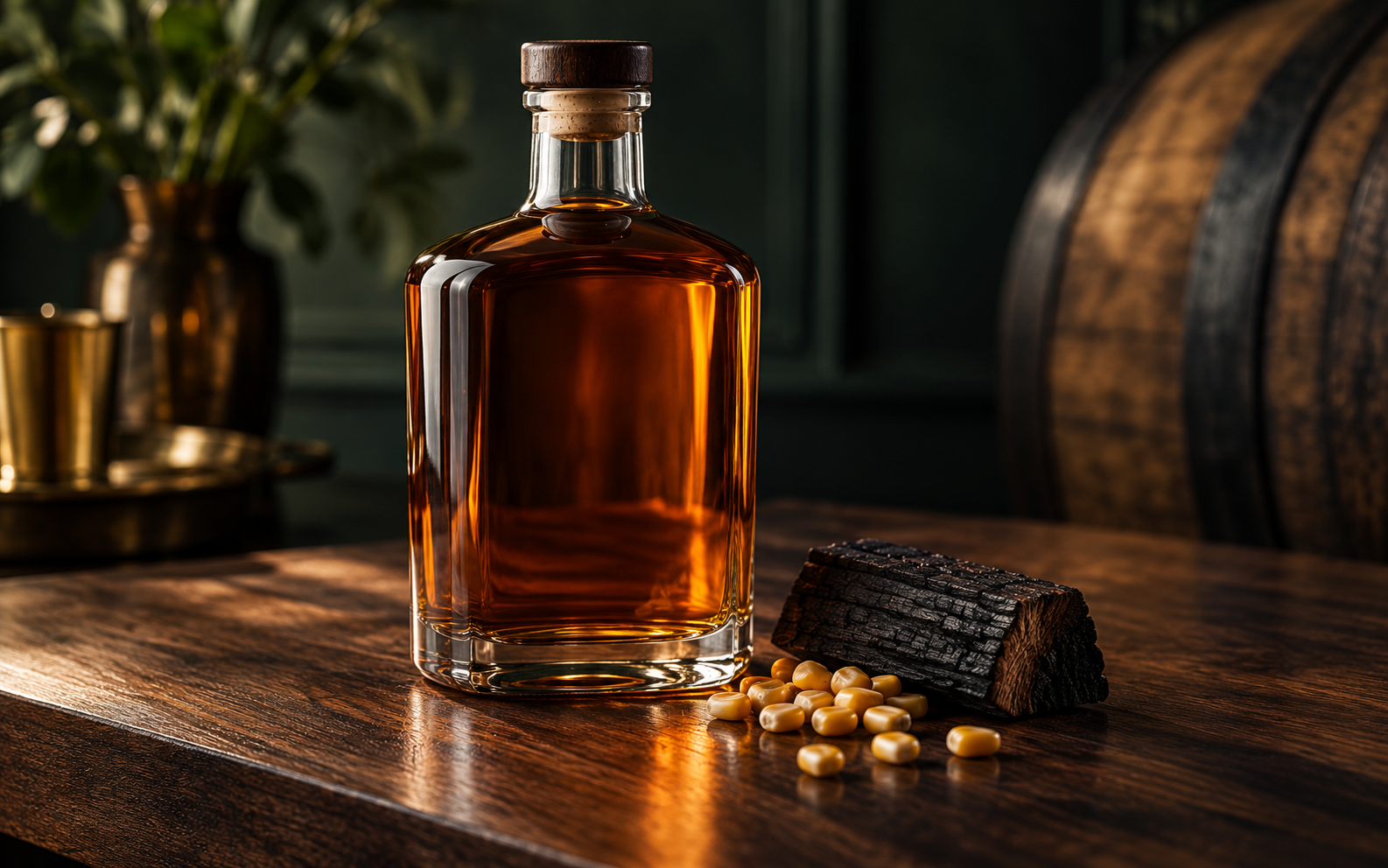
A bourbon shelf can look like a reunion of very distinguished ancestors. There are signatures, portraits, old dates, and enough weathered lettering to furnish a frontier town. Before any whiskey reaches the glass, the packaging has already told you how to feel about it.
Turn the bottle slightly. Somewhere among the romance is a much smaller story, written in production terms. Start with “bourbon.” It is a kind of whiskey, made in the United States from a fermented mash containing at least 51 percent corn. U.S. standards set a distillation ceiling of 160 proof and a maximum entry proof of 125 for storage in charred new oak barrels. Kentucky is central to bourbon's identity, but it is not the only U.S. place allowed to make it. 1
Those numbers describe different moments. Corn percentage is about the grain recipe. Distillation proof concerns the spirit leaving distillation. Barrel-entry proof concerns its strength when it enters the barrel. None of those is automatically the number printed next to “ABV” on the bottle in your hand.
A small word doing useful work
“Straight” is more than a compliment. Straight bourbon has spent at least two years in the prescribed barrels. Plain “bourbon” does not carry that same two-year minimum. That distinction makes the category wording more useful than a beautifully embossed promise about tradition. 1
Now look at the bottled strength. In the U.S. system, proof is twice alcohol by volume: 90 proof means 45 percent ABV. 2 If you are comparing two recipes, the amount poured and the bottle's strength both matter. An ounce of one whiskey is not automatically the same amount of alcohol as an ounce of another.
Imagine choosing a bottle for an Old Fashioned. The label can tell you the category and strength. It cannot tell you whether you will prefer that whiskey with your bitters, your sweetener, and the amount of dilution in your glass. A longer age statement also cannot make that decision on your behalf. You still have a drink to balance.
That is where label reading becomes enjoyable rather than intimidating. You are not studying for a whiskey exam. You are separating information you can use from a story you may simply like. Write down the category, ABV, and any age statement. If the producer discloses the grain proportions, add them. If it does not, leave that space empty.
Then let the handsome ancestor on the bottle return to his proper job: decoration. He may be excellent company. He does not need to choose your cocktail.
Bar-stool FYI. Bourbon is a whiskey category, not a synonym for all American whiskey—and “Kentucky” is not part of its federal production definition. 1
From the story to the shaker
The cocktail detour
Published recipes from other bartenders and producers. These are editorial picks, not a ranked popularity list or historical remedies.
- Old Fashioned ↗The familiar starting point: whiskey, sugar, bitters, and water.
- Boulevardier ↗A bitter, vermouth-rich turn for whiskey.
- Paper Plane ↗A modern sour with two distinctly different bitter liqueurs.